Kenya allows independent driving in several of its national parks, and the option attracts budget-conscious travelers and experienced bush hands alike. But the self-drive vs guided safari Kenya question has a more layered answer than it first appears. Where you go, how much bush experience you carry, and what you want out of the game drive all shape which approach serves you better. This article lays out the practical differences so you can make that call before you land.
Self-Drive vs Guided Safari Kenya: The Core Trade-offs
The table below maps the main factors side by side.
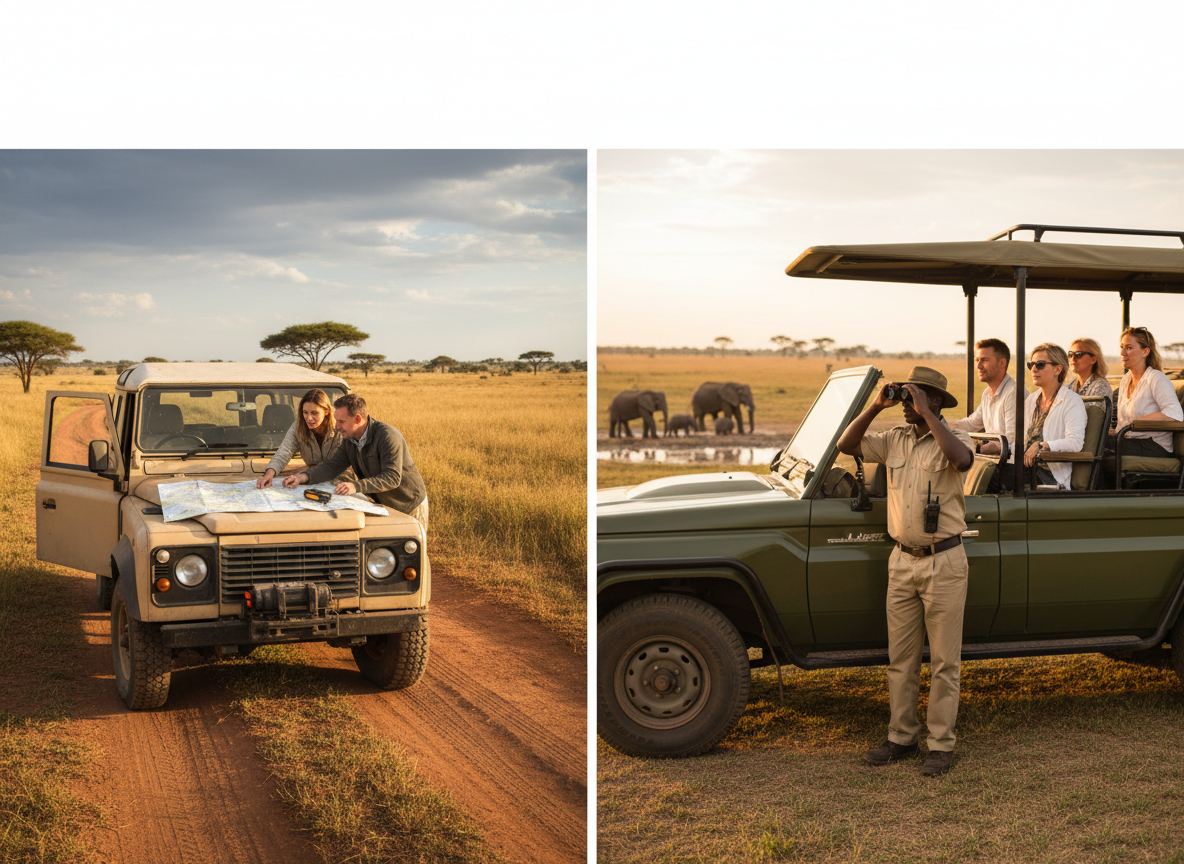
| Factor | Self-Drive | Guided |
|---|---|---|
| Park access | Nairobi NP, Nakuru, Amboseli, Hell’s Gate, Tsavo (with caveats) | All parks and private conservancies |
| Masai Mara | Guide required in most zones | Full access |
| Wildlife knowledge | Your own, plus apps and field guides | Professional training in behavior, ecology, and tracking |
| Navigation | Maps, apps, self-routing | Guide knows current tracks and wildlife locations |
| Cost | Vehicle hire + park fees | Vehicle + park fees + guide fee ($100 to $300/day) |
| Safety | Self-responsible in remote wilderness | Guide carries first aid, comms, and bush emergency knowledge |
| Photography | You control the stop | Guide positions vehicle for light and animal behavior |
| Flexibility | High: your own pace and timing | High: private guides adapt to your interests |
The most significant dividing line is park access. Self-drive is permitted in some parks and effectively ruled out in others.
Where Self-Drive Works in Kenya
Parks That Suit Independent Driving
Nairobi National Park is the most accessible self-drive option in the country. The park sits on the edge of the city, entry is straightforward, and the compact circuit puts rhino, buffalo, lion, and giraffe within reach in a few hours. The backdrop of Nairobi’s skyline behind the savanna makes it unlike any other park in Africa.
Lake Nakuru National Park is similarly manageable. The park is fully fenced, easy to navigate in an afternoon, and known for reliable rhino sightings and seasonal flamingo concentrations along the lakeshore.
Amboseli National Park handles self-drive well. At 392 sq km the park is compact, circuits are clearly marked, and wildlife concentrates around the swamp areas in patterns that make game viewing predictable. Elephants, zebra, and wildebeest are easy to find without guidance, and Kilimanjaro as a backdrop on a clear morning requires no interpretation.
Hell’s Gate National Park is specifically built for independent visitors. You can drive, hike, or cycle the gorge circuit. The park has no big five risk on the main routes, which is why it permits foot and cycle access. The geothermal features and cliffside scenery are worth half a day on any Nakuru itinerary.
Tsavo East and Tsavo West National Parks technically permit self-drive, but the scale changes the risk profile completely. Tsavo East alone covers 11,747 sq km. Tracks are unmarked in sections, floods can cut circuits after heavy rain, and getting genuinely lost in remote Tsavo is not a theoretical concern. Attempt it only if you carry detailed offline maps (Maps.Me or a downloaded KWS layer), a communication device, vehicle recovery gear, and a working spare.
Samburu National Reserve allows self-drive but the terrain is complex. The guide knowledge advantage here is higher than at more compact parks. Samburu specialties including Grevy’s zebra, reticulated giraffe, and gerenuk require knowing exactly where to look, and that knowledge is rarely in the apps.
Where Self-Drive Is Not Practical
The Masai Mara National Reserve requires visitors to use licensed guide vehicles for game drives inside the reserve. Independent private cars are not permitted for game viewing in the main reserve. Some narrow entry exceptions exist, but for all practical trip-planning purposes, the Mara is guided-only.
The private conservancies bordering the Mara, including Olare Motorogi, Naboisho, Mara North, and Ol Kinyei, are exclusively guided. These are private landholdings that require booked camp accommodation and guided activities as the condition of entry. There is no self-drive option here at any budget level.
What a Professional Guide Actually Adds
The value of a guide goes beyond not getting lost.
Behavior reading. A trained Kenyan guide reads an animal’s body language in real time. The lion’s ear angle and tail position signal whether it is relaxed or tensing to move. A specific alarm call from a Go-away bird indicates that a leopard is close and the bush is in a state of alert. This layer of interpretation turns an encounter into an event.
Tracking. Guides follow spoor in dust, read grass compression, and identify from broken branches how recently an animal passed. Finding a cheetah that has shifted territory since early morning is a tracking exercise, not a map exercise. No app replicates it.
Navigation intelligence. Guides know which crossings flood in the long rains, which tracks have been active, and where the wildebeest column has moved since dawn. This is updated daily across a guide network and cannot be downloaded before you leave Nairobi.
Safety. Kenya’s parks contain dangerous wildlife. Breakdowns near buffalo or a lion pride require calm, trained responses. A guide carries radio communication with camp and rangers and knows how to manage a range of bush scenarios that would be genuinely alarming for an unprepared traveler.
Cultural access. A local Kenyan guide connects you to Maasai communities, the history of the land, and the relationship between people and wildlife that shapes everything you see. This is not available from a field guide or an audio tour.
Cost Comparison
Self-drive removes the guide fee but does not make Kenya safari cheap.
Self-drive approximate costs:
- 4×4 vehicle hire: $80 to $200 per day (genuine high-clearance 4×4, not a crossover)
- Park fees: $40 to $80 per adult per day depending on the park
- Fuel: roughly $50 to $100 per day by distance driven
Guided safari approximate costs:
- Guide fee: $100 to $300 per day, or included in all-inclusive camp rates
- Vehicle: usually bundled with the guide or within the camp package
- Park fees: same as self-drive
The actual saving is smaller than it appears. At quality safari camps the guide is built into the all-inclusive day rate, so you are paying for expertise whether or not you think of it as a separate line item. For a first-time visitor to the Mara or Amboseli, the net cost difference between self-drive and a guided camp package may be narrower than expected once vehicle hire and fuel are accounted for.
Explorer Notes
- 4×4 is not optional. Most Kenyan park tracks require genuine high-clearance vehicles. Confirm true off-road capability, not just all-wheel drive, before signing a hire agreement.
- Offline maps for Tsavo. Cell coverage disappears in Tsavo East. Download KWS or OsmAnd layers before leaving Nairobi. Do not rely on Google Maps with a data connection.
- Park fees apply regardless. Kenya Wildlife Service entry fees are fixed for all visitors. Self-driving does not reduce your park cost.
- Rainy season track conditions. Black cotton soil becomes impassable mud in the long rains (April to June). Self-drive in this season adds meaningful risk in larger parks.
- Photography trade-off. Self-drive gives you full control of timing and position. A skilled guide who reads animal behavior will, on balance, get you into better light and closer to action more often. Both have genuine photographic advantages.
Which Option Fits Your Trip
Self-drive makes sense if you have multiple African safaris behind you, are visiting compact parks such as Nairobi NP, Nakuru, Amboseli, or Hell’s Gate specifically, and are comfortable with navigation demands and the responsibility that comes with operating independently in a wilderness area.
A guided safari makes sense if you are visiting the Masai Mara (where it is required), if this is your first or second Kenya trip, if you are traveling with children, or if you want the wildlife behavior context and cultural depth that a trained local guide delivers.
For most Kenya itineraries, and certainly any that include the Mara, a professional guide is not a premium add-on. It is the mechanism through which Kenya’s wildlife reveals what it is actually doing.
Turn this reading into a real itinerary with help from a Kenya-based safari team.
Start Planning Your Safari